Preclinical CRO Market to reach USD 15.09 Billion by 2035 at 8.0% CAGR
Preclinical CRO Market to Surge from USD 6.99 Billion in 2025 to USD 15.09 Billion by 2035—Powered by Asset-Light
Press Release Disclaimer: This is a press release distributed through the XPR Media network. It has not been independently verified by our newsroom.
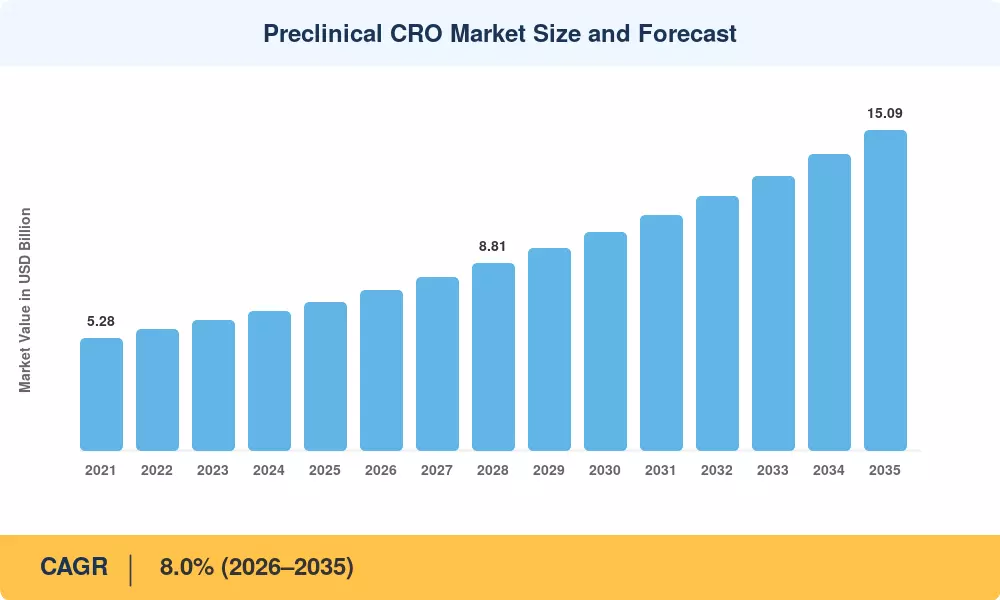

Preclinical CRO Market to Surge from USD 6.99 Billion in 2025 to USD 15.09 Billion by 2035—Powered by Asset-Light Sponsor Models, Regulatory Modernization
NY, CA, UNITED STATES, September 18, 2026 /EINPresswire.com/ — As per Market Research Future, the global Preclinical CRO Market size is projected to reach USD 15.09 Billion by 2035 from USD 6.99 Billion in 2025, at a CAGR of 8.0% during the forecast period 2026–2035. The market base was estimated at USD 6.99 Billion in 2025, with the first year of the forecast period (2026) valued at USD 7.55 Billion.
The 8.0% CAGR is propelled by three converging forces: asset-light sponsor models, with virtual and semi-virtual biotechs originating a substantial slice of new molecular entities and outsourced discovery spend rising above 62% of total early-stage budgets; regulatory modernization, with the FDA Modernization Act 2.0 removing the statutory requirement for animal testing in every investigational new drug application and legitimizing alternative safety packages; and Asia-Pacific cost structure, with study execution in China and India running 35–45% below comparable North American pricing for equivalent GLP scope.
Global policy shifts and capital investment are amplifying this momentum. In 2024, biotechnology firms raised over USD 24 billion globally, with a disproportionate amount invested in virtual corporations with no laboratory footprint at all. India’s Department of Pharmaceuticals allocated INR 5,000 crore under its Promotion of Research and Innovation in Pharma MedTech Sector scheme, part of which underwrites contract research infrastructure. North America commands 42.0% of 2025 revenue on regulatory proximity and dense accredited capacity, contributing USD 2.94 billion, while Asia-Pacific has the highest growth rate at 10.1% CAGR, driven by cost arbitrage in China and India. Europe accounted for 27.5% of 2025 revenue with a mature chemical safety base and standardized ICH adoption.
Request A Free Sample:
https://www.marketresearchfuture.com/sample_request/7274
Key Market Trends & Growth Drivers
Asset-Light Sponsor Models
Virtual and semi-virtual biotechs now originate a substantial slice of new molecular entities, and almost none maintain their own accredited vivarium. Analysis of 2024 research and development disclosures across mid-cap sponsors shows outsourced discovery spend rising above 62% of total early-stage budgets, up roughly eight percentage points in four years. That structural change converts fixed internal cost into contracted variable cost, and it lands directly on preclinical providers who can absorb full IND-enabling packages.
Regulatory Modernization
Passage of the FDA Modernization Act 2.0 in December 2022 replaced mandatory animal testing language with a broader evidence standard covering organ chips, computational models, and cell-based assays. Providers responded by qualifying alternative platforms rather than abandoning classical work. The practical result has been additive: sponsors now commission both a conventional package and a supporting new-approach-methodology dataset, lifting per-program spend by an estimated 9–14% on affected filings.
Asia-Pacific Cost Structure
Study execution in China and India runs 35–45% below comparable North American pricing for equivalent GLP scope, and turnaround on non-rodent capacity is often shorter. India’s Department of Pharmaceuticals allocated INR 5,000 crore under its PRIP scheme, part of which underwrites contract research infrastructure. Western sponsors increasingly split packages, running pivotal toxicology domestically while placing screening tiers offshore.
Safety Pharmacology Intensification
Revised ICH S7B and E14 guidance introduced a best-practice framework for proarrhythmia risk assessment, expanding the in vitro and in vivo evidence expected before first-in-human dosing. Novel modalities including bispecifics and gene therapies carry liability profiles that historical datasets do not cover well. Safety pharmacology consequently grows at 11.4% annually, outpacing every other service line.
Ask for Customization:
https://www.marketresearchfuture.com/ask_for_customize/7274
Market Segment Insights
BY SERVICE
Toxicology Testing: Largest segment with 37.7% share in 2025 , the single largest service pool. Toxicology remains the revenue backbone because no filing route avoids it entirely—the evidence standard changed, the evidence requirement did not.
Safety Pharmacology: Fastest-growing service at 11.4% CAGR (2026–2035) , driven by cardiovascular liability screening tightening under revised ICH S7B proarrhythmia framework. Novel modalities generate liability questions that legacy datasets cannot answer.
Bioanalysis and DMPK Studies: Significant segment at USD 1.99 Billion in 2025, driven by regulated bioanalytical method validation.
BY MODEL TYPE
Patient-Derived Xenograft (PDX) Models: Largest segment with 49.8% share in 2025 , driven by established oncology translational validity. Xenograft models retain their lead on the strength of a two-decade regulatory track record that reviewers trust.
Patient-Derived Organoid (PDO) Models: Fastest-growing model class at 12.9% CAGR (2026–2035) , driven by faster, higher-throughput tumor screening. Organoids are winning the screening tier first—where speed and donor diversity matter more than precedent.
In-Silico / AI-Driven Models: Significant segment with 22.6% share in 2025 , driven by early liability prediction and cost reduction.
BY END USER
Biopharma & Pharma Companies: Largest segment with 59.2% share in 2025 , driven by pipeline volume and outsourcing mandates. Biopharma sponsors dominate spending and set its pricing conventions, though their share is slowly diluting.
Academic & Research Institutes: Fastest-growing end user at 11.0% CAGR (2026–2035) , driven by translational grant funding expansion. Translational funding pushes university programs toward IND-quality data they cannot generate internally.
Medical Device Companies: Significant segment at USD 0.99 Billion in 2025, driven by biocompatibility and implant safety testing.
Read Detailed Insights:
https://www.marketresearchfuture.com/reports/preclinical-cro-market-7274
Regional Outlook
North America — Dominant Market (~42.0% Share, 2025)
United States: Holds 84.5% of regional revenue , driven by FDA proximity and accredited site density. The National Center for Advancing Translational Sciences committed sustained funding to tissue-chip validation, seeding a domestic alternative-methods ecosystem that providers now commercialize.
Canada: Growing at 7.4% CAGR (2026–2035) , driven by Scientific Research and Experimental Development tax credits. Toronto and Montreal have both added specialty bioanalysis capacity since 2023.
Mexico: Contributes USD 0.13 Billion, driven by nearshoring of laboratory services.
Europe — Second Largest (27.5% Share, 2025)
Germany: Holds 24.8% of regional revenue , driven by chemical and pharmaceutical safety base. Germany’s chemical safety infrastructure—built originally for REACH compliance—cross-subsidizes pharmaceutical toxicology capacity.
United Kingdom: Growing at 7.3% CAGR (2026–2035) , driven by Life Sciences Vision funding.
France: Contributes USD 0.27 Billion, driven by national oncology cluster demand.
Italy: Holds 9.6% of regional revenue , driven by contract manufacturing spillover.
Spain: Growing at 7.5% CAGR (2026–2035) , driven by cost-competitive GLP sites.
Nordic Countries: Contribute USD 0.14 Billion, driven by academic translational partnerships.
Russia: Holds 3.8% of regional revenue , driven by domestic substitution programs.
Rest of Europe: Growing at 6.6% CAGR (2026–2035) , driven by Central European capacity growth.
Asia-Pacific — Fastest-Growing Region (10.1% CAGR, 2026–2035)
China: Holds 38.4% of regional revenue , driven by integrated discovery platforms at scale. Domestic providers built end-to-end platforms that compress discovery-to-IND timelines below Western benchmarks.
India: Fastest-growing in the region at 12.4% CAGR (2026–2035) , driven by PRIP scheme and skilled scientific labor. India differentiates on scientific labor economics rather than pure throughput.
Japan: Contributes USD 0.29 Billion, driven by PMDA-aligned domestic programs.
South Korea: Holds 8.9% of regional revenue , driven by biosimilar and cell therapy pipelines.
ASEAN: Growing at 10.6% CAGR (2026–2035) , driven by Singapore and Malaysia capacity additions.
South America — Growing Presence (USD 0.32 Billion, 2025)
Brazil: Holds 58.2% of regional revenue , driven by ANVISA modernization and local pipelines. Capacity remains thin, with most pivotal toxicology still routed to North America.
Argentina: Growing at 8.1% CAGR (2026–2035) , driven by academic biotech spinouts.
Middle East & Africa — Emerging Opportunity (8.8% CAGR, 2026–2035)
Saudi Arabia: Holds 27.4% of regional revenue , driven by Vision 2030 biotech localization. The National Biotechnology Strategy targets domestic capability across the development chain by 2030.
UAE: Growing at 9.6% CAGR (2026–2035) , driven by free-zone research infrastructure.
South Africa: Contributes USD 0.05 Billion, driven by infectious disease research base.
Egypt: Holds 11.2% of regional revenue , driven by pharmaceutical manufacturing cluster.
Competitive Landscape and Recent Developments
Concentration is moderate, with the top five providers accounting for around 38-43% of global revenue. Below the leaders, there’s a long tail of regional and specialist providers competing on turnaround and therapeutic focus rather than breadth.
KEY COMPANIES AND RECENT MILESTONES
Charles River Laboratories (February 2025): Announced a strategic review and portfolio restructuring following softer demand from small-cap biotech clients, reshaping capacity planning across the sector. Scale leader with integrated model sourcing. Estimated ~15–19% revenue share.
Labcorp Drug Development: Diagnostics-linked data advantage with toxicology, bioanalysis, and discovery services. Estimated ~7–10% revenue share.
WuXi AppTec: Cost and speed leadership in Asia-Pacific with integrated discovery-to-IND platforms. Estimated ~6–9% revenue share.
Inotiv (October 2024): Completed consolidation of multiple US toxicology sites to lift utilization and reduce fixed-cost exposure. Consolidator of US mid-tier capacity. Estimated ~4–6% revenue share.
ICON plc: Clinical continuity for sponsors with early development and bioanalytical services. Estimated ~3–5% revenue share.
Eurofins Scientific: Distributed laboratory network with bioanalysis, biocompatibility, and GLP testing. Estimated ~3–5% revenue share.
Evotec SE (June 2024): Expanded its AI-driven discovery partnership framework, extending in-silico liability screening into partner pipelines. Science-led partnership model. Estimated ~2–4% revenue share.
Other Key Players: Pharmaron (~2–4%), Frontage Laboratories (~1–3%), Crown Bioscience (~1–3%), Altasciences (~1–3%).
Recent Industry Developments:
US FDA (April 2025): Published a roadmap to reduce animal testing requirements for monoclonal antibodies, prioritizing computational and human-cell-based approaches.
India Department of Pharmaceuticals (March 2024): Opened PRIP scheme funding windows covering contract research infrastructure and translational facilities.
NMPA China (November 2023): Advanced ICH guideline implementation, improving mutual recognition of domestically generated preclinical dossiers.
ICH (February 2023): Finalized the S7B/E14 question-and-answer framework establishing best practice for proarrhythmia risk assessment.
Saudi Arabia (December 2023): Launched the National Biotechnology Strategy with dedicated allocations for research infrastructure through 2030.
Future Outlook: 2026–2035
The Preclinical CRO Market is projected to reach USD 15.09 Billion by 2035, growing at a CAGR of 8.0%, driven by asset-light sponsor models, regulatory modernization, and Asia-Pacific cost structure.
New opportunities lie in:
Organoid-Led Oncology Screening: Patient-derived organoid panels reproduce tumor heterogeneity with shorter cycle times than xenograft colonies, and they scale across hundreds of donor lines. Providers building biobanked organoid libraries can price per-compound screening rather than per-animal.
New Approach Methodology Qualification Services: Sponsors need help proving that organ-on-chip or computational evidence will survive review. A qualification advisory line—protocol design, historical control curation, regulatory correspondence—carries consultancy economics on top of laboratory revenue.
Emerging-Market Capacity Build: Brazil, Saudi Arabia, and the ASEAN bloc have all announced life-science localization programs, and none currently hosts sufficient accredited preclinical capacity to serve domestic pipelines.
Historical Control Data Monetization: Decades of control-arm results sit unused inside provider archives. Curated, de-identified historical control databases licensed to sponsors reduce animal use and generate recurring subscription revenue.
Integrated Discovery-to-IND Packages: Sponsors increasingly prefer one accountable partner across pharmacology, DMPK, and safety rather than four vendors and a coordinator. Bundled programs command 12–18% pricing premiums.
Computational Displacement, Not Replacement: Machine learning models trained on curated historical control data will intercept a growing share of failures before any animal is dosed, with realistic projections suggesting computational triage removes 15–20% of low-value studies by 2032.
By 2035, the Preclinical CRO Market is expected to achieve substantial growth, reflecting the transformation of preclinical research from fixed internal cost to contracted variable cost and the shift toward alternative methodologies.
More Related Research Insights:
https://www.marketresearchfuture.com/press-release/nicotine-oral-dissolvable-thin-films-market
https://www.marketresearchfuture.com/press-release/peptides-market
https://www.marketresearchfuture.com/press-release/personal-hygiene-market
https://www.marketresearchfuture.com/press-release/radiation-protection-apparels-market
https://www.marketresearchfuture.com/press-release/radioligand-therapy-rlt-market
https://www.marketresearchfuture.com/press-release/rapid-sterility-testing-market
https://www.marketresearchfuture.com/press-release/reading-glasses-market
https://www.marketresearchfuture.com/press-release/real-time-pcr-qpcr-market
https://www.marketresearchfuture.com/press-release/refurbished-medical-devices-market
https://www.marketresearchfuture.com/press-release/renal-dialysis-market
Market Research Future
Market Research Future
+1 855-661-4441
email us here
Legal Disclaimer:
EIN Presswire provides this news content “as is” without warranty of any kind. We do not accept any responsibility or liability
for the accuracy, content, images, videos, licenses, completeness, legality, or reliability of the information contained in this
article. If you have any complaints or copyright issues related to this article, kindly contact the author above.

Media gallery